
 As we’ve seen again and again on this blog, misogynists love to talk about how much better men are than women when it comes to things like math, logic, and scientific thinking generally. Unfortunately, their posts and comments online – filled with breathtaking failures of logic, absurd unsourced assertions and magical thinking — do not seem to bear out this hypothesis. I would compare the scientific thinking of most manosphere misogynists with that of the creationists, but frankly that would be insulting to creationists.
A case in point: a graph – provenance unknown – posted in a recent MGTOWforums discussion of marriage. The standard line amongst the lady haters is that marriage is on the way out , because men are “waking up” to the evils of marriage in an allegedly feminist state and deciding to, well, go their own way. The reality: while the marriage rate has been falling fairly steadily for the last quarter-century or so, for a variety of reasons, most people do marry at some point in their lives; it would be silly to assume that a trend over the course of several decades heralds the death of a social institution that has lasted (and has had many previous ups and downs) for millennia.
Of course, that’s not the way the MGTOWers in question see it. Their proof that marriage is doomed – doomed, I say – lies in this little graph which charts with mathematical precision the exact date range within which marriage will vanish forever from this good earth:

Now, there are many problems with this little graph. For one thing, what happens AFTER the projected marriage rate goes to zero? Does the marriage rate bounce like a rubber ball back into the positive realm? Or does it go below zero, with unmarried couples divorcing one another – just in case?
Second, this chart is based on a tiny number of data points – a mere 25 year sliver of the millennia-long history of divorce. If you go back a mere century and a half – see the chart below, taken from a paper you can find here — you’ll see that the marriage rate doesn’t conform to any neat mathematical formula; it jumps up and down, affected not only by slow-moving cultural changes but by events in the real world – look at the gigantic spike in marriage after World War II.
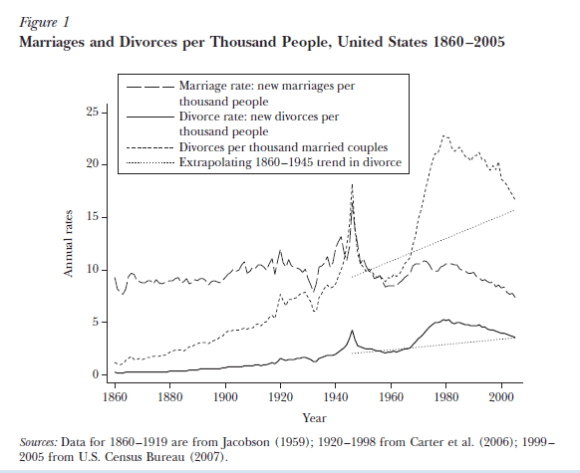
But the main issue here is that there is simply no way you can come up with a neat equation to predict the future of marriage because THE WORLD DOES NOT WORK THAT WAY. History isn’t math. It cannot be predicted in advance, and any attempt to do so — especially one based on a tiny sliver of data — is doomed to failure. (Well, certain aspects of reality can be predicted — like when Halley’s comet will next return (assuming it’s not eaten by a giant space monster we haven’t discovered yet). Orbits can be calculated with mathematical precision; social trends cannot.)
To illustrate the dangers of extrapolation, let’s consider the little chart below, prepared by a helpful assistant (who happens to have access to a scanner). The chart provides some interesting data on the age of a hypothetical cat named “Fluffy” and her projected life expectancy. As you can see, Fluffy was hypothetically born in 2001, making her ten years old today, with her age increasing by one every year. (Just pretend that the numbers line up properly; my assistant, despite her many other charms, is not big on precision, and may have been drunk when she prepared this chart.) Based on this data (which show Fluffy’s age increasing by one every year), we could project that by the time the next century rolls around our dear little cat will be 99 years old.

If projecting the future were as easy as drawing little lines on graphs, the world would be a much simpler, and much less interesting, place to live. Most of us realize this. MRAs and MGTOWers, not so much.


